
Turn your trusted docs into reusable parts.
Create videos, decks, cited answers, and input to AI agents.
Truframe reads a PDF, Word file, slide deck or web page and pulls out its real parts (charts with their data, tables with their cells, equations, figures) as separate objects. Everything built from them cites the page it came from. When a new version arrives, you see what changed, object by object, through the API.
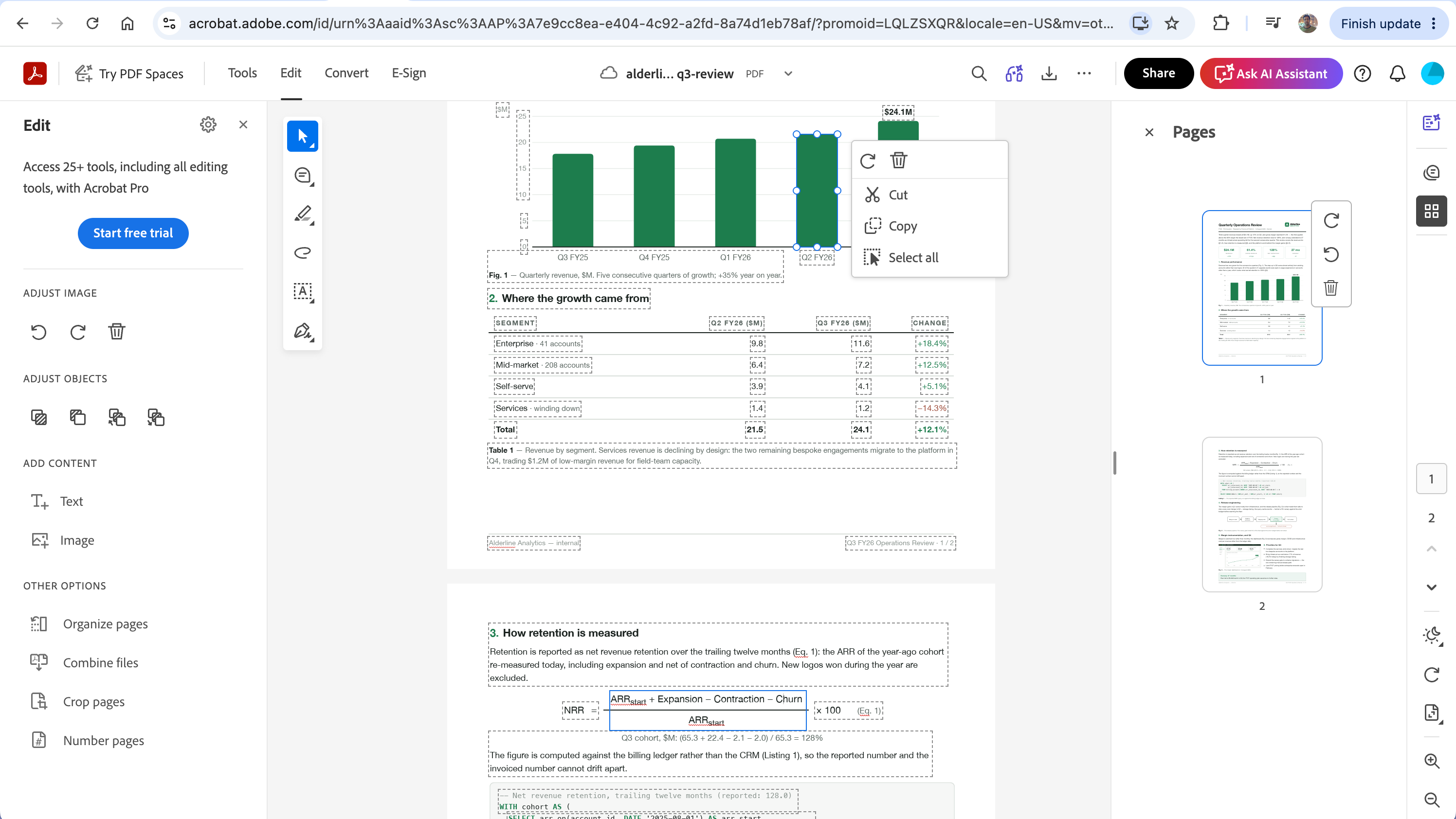
Not a mockup — the editor itself, taking apart a real page.
Then flip between the extraction and the original — 100% coverage, nothing dropped.
What a document becomes
Truframe takes a document apart into the things it is made of, and every use case runs on those parts.
- Sections
- Paragraphs
- Tables · cells
- Charts
- Vector figures
- Equations
- Video
- Deck
- RAG
- QA
- Evidence
- Versions
- Diff
- Watch
- API
- MCP
A PDF editor preserves the page. Truframe recovers the document.
Four things you do with a document
Once a document is in parts, the same parts feed everything below — a video, an answer, a version check, your own agent.
Create
LivePick a use case, point it at a section, get a video, deck or PDF.
- Walkthroughany document walked through step by step, every line cited
- Video lessona chapter animated — formulas derived, figures rebuilt to move
- Explainerone idea explained properly, with the document's own figures
- Product overviewdocs and release notes become a what's-new deck
- Leadership updatea briefing compiled from the report, its numbers intact
One storyboard, three renders: video, deck and PDF. See the examples below.
every line cites its source
Real documents, and what was made from them
Not mockups. Each source is beside its output, so you can check one against the other.


Maxima & Minima, Grade 12 revision notes. Written by Truframe for this example. Open the PDF
3 min 27 s · 1080p, voiced. Each idea is built on screen as it is explained: the slope argument derived step by step, the graphs drawn so they move.


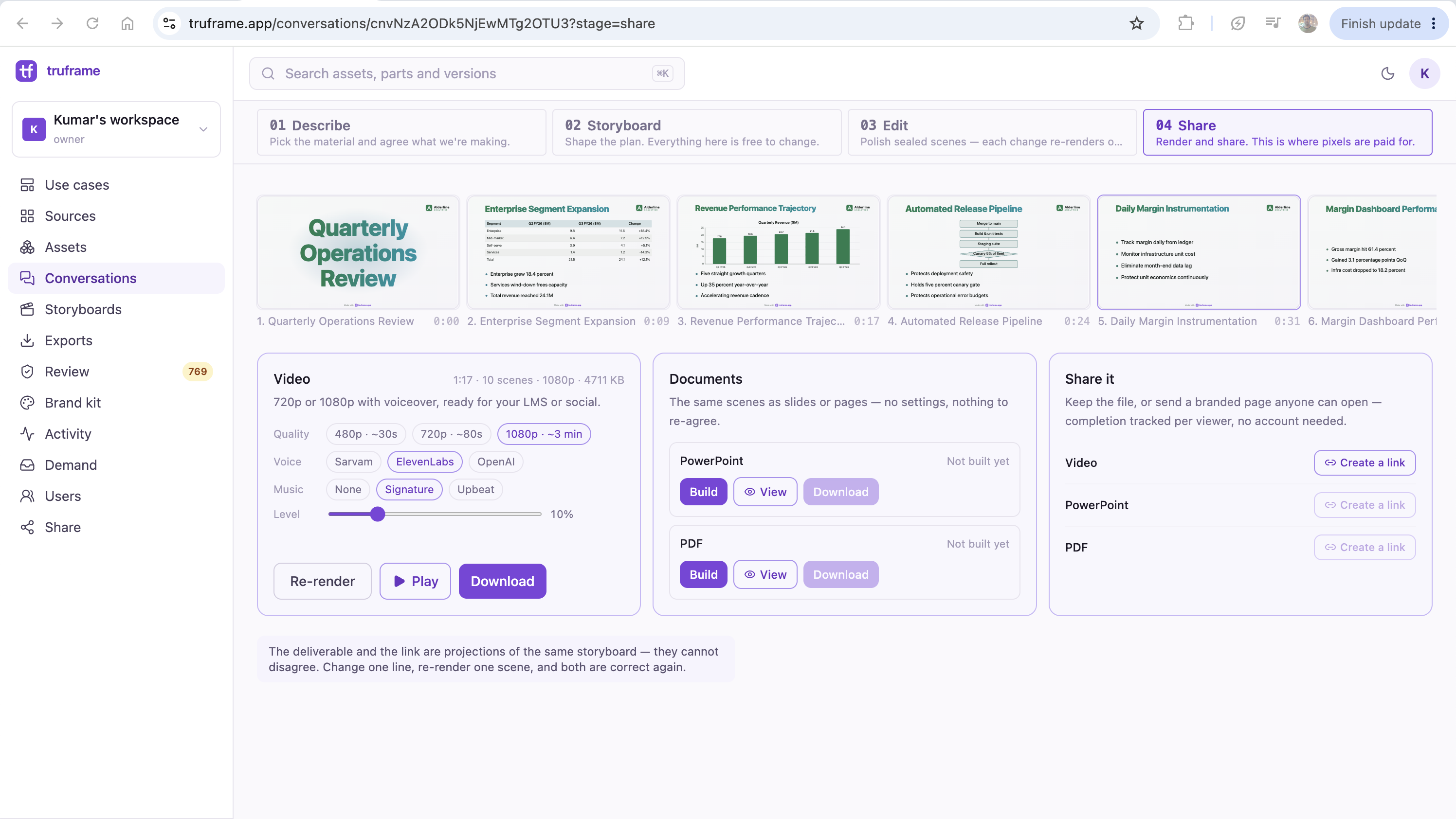
1 min 44 s · 1080p, voiced and subtitled. Ten scenes, approved one by one. The figures on screen are lifted from the pages on the left.
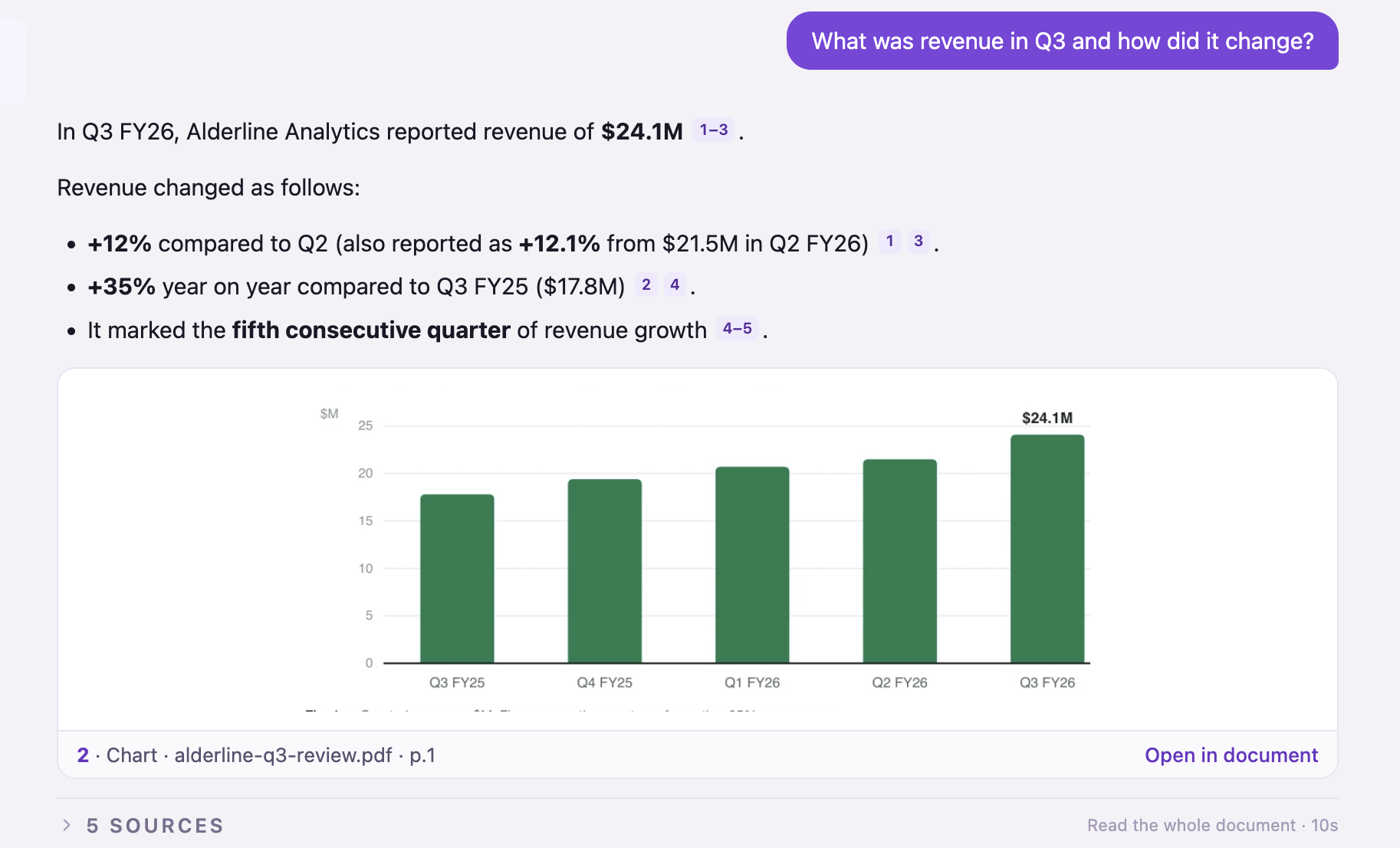
Ask, in the app. Each figure carries its citation, and the chart it came from is shown under the answer, one click from its place on the page.
A storyboard that can't leave your documents.
Each step is priced per unit — a reply, a scene, an edit, a minute of video — and the cost is shown before it runs. The storyboard is the control surface — you direct, the model drafts, and nothing renders without your approval.
Answers can only come from what you attach. Nothing else is in scope.
What it looks like in your industry
One document per industry, taken apart — and what each team makes, asks and automates from the parts.
Product, compliance and customer-communication teams at insurers
- 01Sub-limit tableTable 4 · p.12
- 02ExclusionsClause 6.2 · p.31
- 03How to claimAnnexure B · list
- Customer explainer video
- Advisor walkthrough
- Branch handout (PDF)
"Is cataract covered in year 1?" — answered with Clause 6.2 and the sub-limit row. An underwriting or claims agent gets those two objects, not the whole wording.
The next wording is matched clause by clause, and the diff names the clauses that changed.
Compliance, operations and training teams at banks and NBFCs
- 01Due-diligence procedureChapter · list
- 02Periodic review limitsTable
- 03Accepted documentsAnnex · list
- Staff briefing video
- Leadership update deck
- Branch job aid (PDF)
Cited answers across the direction and every circular that amends it — each sentence opens the paragraph it came from.
Watch the regulator's page: a re-fetch that changes content becomes a new version, a diff and a webhook to your system.
QA, training and regulatory teams in pharma and medical devices
- 01Three-rinse procedure§4.2 · list
- 02Acceptance limitsTable 3 · p.14
- 03Rinse sequenceFig. 4.2 · p.11
- Training walkthrough
- Training deck
- Assessor handout
"What is the acceptance limit after the third rinse?" — answered from Table 3, with the row shown.
Rev 7 arrives: the diff shows §4.2 changed and Table 3 did not.
Technical writers and training managers — manufacturing, energy, equipment
- 01Isolation diagramFig. 7.1 · p.61
- 02Seal replacementFig. 7.4 · p.63
- 03Torque sequenceTable 7.2 · p.64
- Technician walkthrough with the manual's own drawings
- Toolbox-talk deck
- Illustrated job aid
The torque table as data — rows and cells, ready for a checklist app or an agent, not a picture of a table.
A revised torque table is matched to the old one, and the diff shows which cells moved.
Publishers, test-prep companies and course teams
- 01Fourier's lawEq. 4.3 · p.88
- 02Flux through a wallFig. 4.3 · p.90
- 03Composite wallWorked example 4.2
- Video lesson: derivations on screen, figures rebuilt to move
- Revision deck
- Student handout
Questions answered from the chapter only, with the equation or figure shown beside the answer.
The new edition is matched section by section; the diff lists what changed before the lessons are rebuilt.
Agencies & consultancies: build all of this for your clients, from their documents.
Don't compare the brochure. Compare the behavior.
Same document. Similar challenge. See how leading AI tools handle it—and what Truframe does differently. Download the source and run the test yourself.
Screenshots taken 29 August 2026. These products change quickly — this is what the same upload produced that day.
They all read the words. Truframe understood what they meant.
The model drafts. Your team decides.
Automation fills a defined shape. It never invents new kinds of content, never overwrites a person's edit, and flags what it wasn't sure about so someone can look.
These are properties of how content is stored, not features bolted on afterwards. Every line below is a column or a constraint in the schema — if one stopped being true, something would fail to compile rather than quietly drift.
Every edit attributable
One command log per draft: who, when, and its exact inverse for undo.
Versions sealed on approval
A sealed version is immutable. Approved content stays as approved.
Roles per workspace
Owner, admin, editor and viewer, enforced on every write path.
Provenance to the source version
Citations pin the version they were written from, so drift is answerable later.
Revocable share links
A share link can be revoked at any time, and completion is counted per viewer rather than per hit.
Customer pages carry no tracking
A page you send a customer records that it was opened, and nothing about who opened it — no IP, no user agent, no cookie.
Give Truframe a document. See what it understands.
Send us a document you already trust. We'll compile a few pages of it — the objects, and a video built from them with every line traceable to its page — and email you the link.
Send us a documentAccounts are set up after a demo, so nothing renders that you haven't asked for.